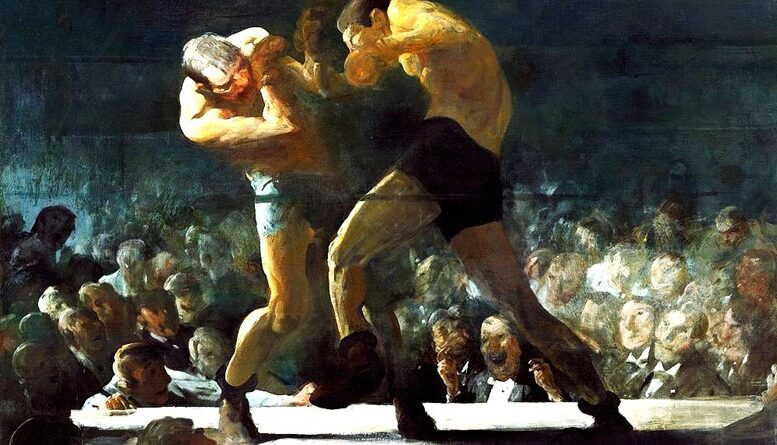
Both Members Of The Club
Thanks to legendary scribe Jimmy Cannon, fans of boxing often refer to pugilism as “the red light district of sports,” and there is no shortage of real-life evidence to back up that old saw, from fixed fights, to cheating managers, to lousy decisions, to punch-drunk boxers barely scraping by years after they earned millions. Plenty of boxing stories have explored this on page and screen, but Adam Berlin’s novella, Both Members of the Club, gives these themes a new accent. That’s what makes the book a compelling read, and something fresh in the narrative history of down-and-out fighters.
The story revolves around three friends, Sam, Billy and Gabriel. The trio grew up together in a group home after surviving parentless childhoods and the story picks up when they are all in their 20’s and living in New York City. Billy is a professional boxer who has recently suffered a few losses due to his tendency to get cut during bouts. Sam, a fledgling artist, and Gabriel, an aspiring actor, try to help their friend find a different way to make a living, one that doesn’t involve so much blood and pain, but Billy pushes forward with his ring ambitions, eventually journeying over to Paris in an attempt to reinvigorate his career. When Gabriel follows Billy over to Europe, he gets into the fight game himself, and what he does ends up fundamentally changing the relationship between all three friends.

Like with all boxing scribes, Berlin is at his best when he provides tactile details of what it is like to be a professional pugilist. As Billy talks about his proclivity for being cut, he also talks about what it takes to heal: ‘”One hundred days,’ Billy says. ‘One percent a day. That’s how long it takes a cut to heal before you can fight again. That’s my clean.'” This kind of visceral, insider info isn’t what fans usually hear about on pay-per-views, and so these details add some wonderful texture. Like most fans, I couldn’t possibly count the number of fights I have watched over the years, but that idea of a specific timeline for a cut healing was still a new way to understand that particular aspect of a fighter’s trade.
Another strength of Both Members of the Club, which won The Clay Reynolds Novella Prize, is that Berlin’s writing style compliments the content. He uses a terse prose, minimalist in a way that’s often been called masculine, but which I would describe as stern, direct, or even Spartan, given the combat he’s often describing: “I watched the two fighters press into each other and punch each other in the middle of the ring. It’s not that hard to watch. Heads snap. Bodies bend. Rounds go by.”
This style also comes out when Berlin isn’t writing about a fight, which helps to sustain the atmosphere and tension of the story from start to finish. The combat isn’t always physical. Here, Berlin uses a deft boxing simile, but he’s also talking about the mental and emotional struggle of his character: “It’s time to leave. Leave this apartment. Leave this city. Just leave. I’ve been thinking about California, a country’s width away. Not Hollywood but somewhere warm where I can run in the mornings and go to work somewhere and the streets aren’t always crowded and always fast like a punch you can’t slow.”
Berlin also makes reference to the ways boxing manifests in other art forms, particularly visual art. The book’s title is taken from the famous painting “Both Members of This Club” by George Bellows, and several famous boxing images play a role in this book. Given the fact that the two settings of the story are the historic locales of New York City and Paris, Berlin’s nods to the cultural and artistic legacy of pugilism adds weight and texture to his tale.

Both Members of the Club is a novella and while naturally a reader should not expect the same kind of depth as might be offered in a longer work, I still couldn’t help wanting more at different points in the story. Some of the scenes in Paris went by too fast for me, and so when the characters return to New York my reading experience felt a bit like whiplash. And strictly as a boxing fan, I would have loved it if Berlin dug a little deeper into the Parisian boxing scene as that’s something I’m not familiar with, and I would bet many Anglophone boxing fans aren’t either.
All that said, to want more out of a book after finishing it is rarely an indictment of the writer. Berlin does a fine job with a compelling story and one could easily read this book in a single day or even a single sitting, it is that engaging. Any fan of boxing literature will want to check out Both Members Of The Club. –Joshua Isard